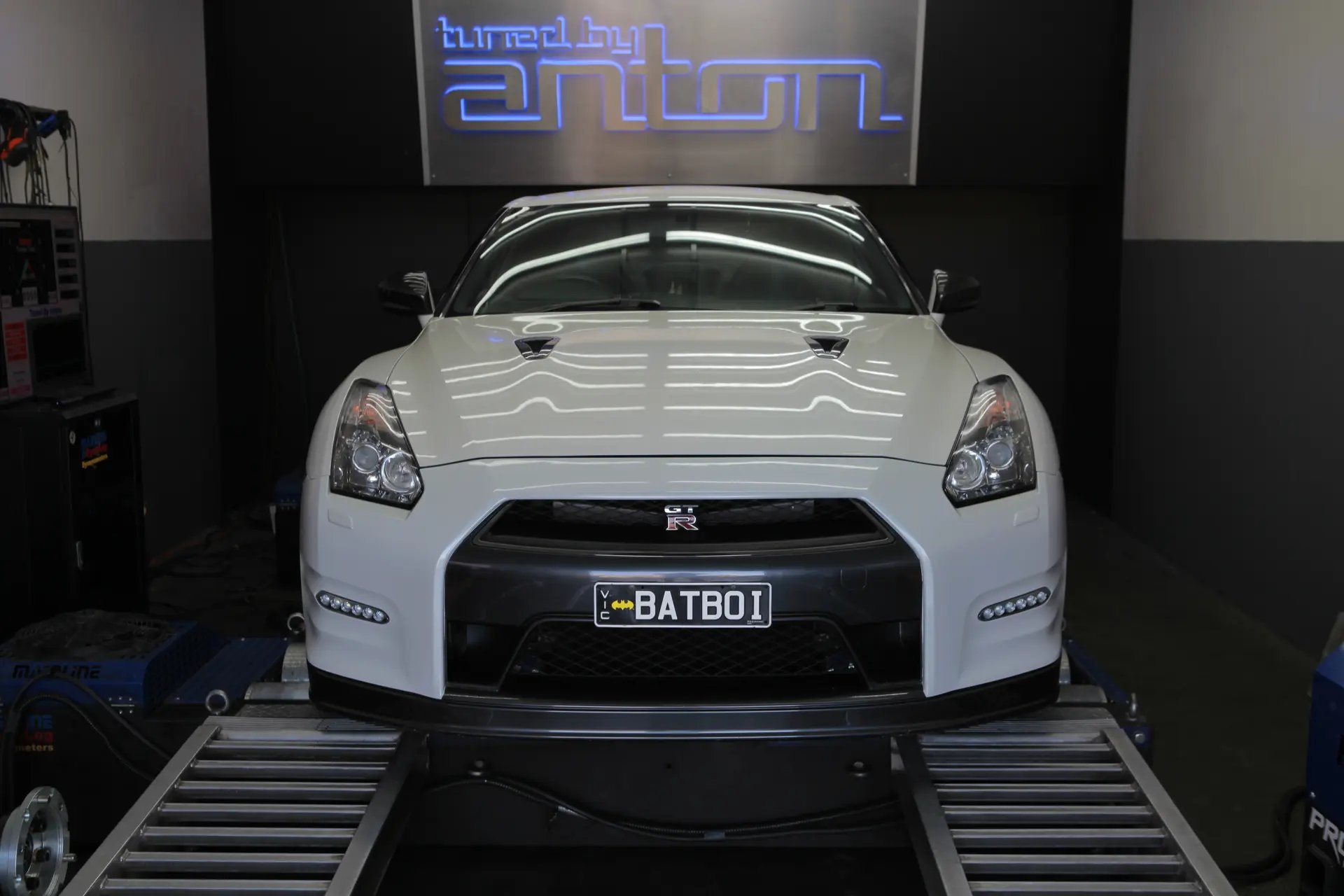
Nissan GT-R R35
tuning in
Melbourne.
What the VR38DETT is capable of at every stage: dyno-verified numbers, ECU options, and what the platform genuinely needs to reach its potential.

Tuned by Apex Workshop
Mainline AWD dyno · 1,500+ tunes · Epping, VIC
TL;DR · the key numbers
Factory internals handle 700–800kW on the right hardware. Nissan's conservative ECU calibration leaves a large gap between factory output and platform potential.
Stage 1 on 98 RON gains ~70–80kW at the wheels. On E85, gains of ~100–130kW are typical, with no hardware required beyond the tune.
The GT-R ECU and TCU must always be calibrated together. The factory GR6 TCU will limit engine torque to protect the clutches if left untouched.
Factory IHI turbos support up to ~600–650kW on E85. Beyond that, upgraded turbos and a built GR6 are required.
01 · The VR38DETT
Built with
headroom.
The R35 GT-R is one of the most tuneable platforms ever built. Nissan designed the VR38DETT with significant headroom: factory internals handle 700–800kW on the right hardware, and the factory fuelling system supports meaningful Stage 1 gains with nothing more than a laptop.
The 3.8-litre twin-turbo V6 is a remarkably strong engine in factory form. Nissan's conservatism in the factory calibration means there is a large gap between factory output and what the hardware is rated to handle. The result: significant gains with minimal hardware investment at the lower stages.
The table below shows dyno-verified averages from GT-R builds we have completed on the Mainline AWD dyno. Individual results depend on the car's condition, ambient conditions on the day, and whether an E85 or flex-fuel system has been fitted.
Dyno-verified averages at the wheels on our Mainline AWD dyno. Results vary by vehicle condition, ambient temperature, and modification level.
02 · Stage 1 tune
Maximum gain,
zero hardware.
A Stage 1 GT-R tune is a recalibration of the factory Nissan ECU. The factory boost targets are conservative, particularly in the low-mid range where the car spends most of its time on public roads. A Stage 1 calibration addresses:
- 01Boost pressure targets across the RPM range
- 02Ignition timing, retarded significantly from factory to accommodate poor global fuel quality
- 03Cam timing (VVEL system) optimisation
- 04TCU shift points, torque limits, and launch control parameters
Critical: TCU calibration
The GT-R's GR6 dual-clutch transmission must be tuned alongside the ECU on any Stage 1 build. The factory TCU will limit engine torque to protect the clutches if left untouched. We never tune the GT-R ECU without also calibrating the TCU.
03 · Stage 2: supporting hardware
Fuelling, cooling,
and E85.
Stage 2 focuses on fuelling and cooling, allowing more aggressive boost targets and full E85 capability. These are the components that move the needle beyond Stage 1.
High-flow intake
Motordyne, Intec, or equivalent aftermarket intake system
Upgraded intercoolers
Factory units become a bottleneck above 500kW; front-mount or upgraded bar-and-plate units are required
High-flow injectors
For E85 support, 1,000cc+ port injectors or supplementary port injection
Upgraded fuel pump
A single upgraded in-tank pump covers most Stage 2 applications
E85 or flex-fuel system
The best bang-for-dollar modification on the GT-R after the base tune
04 · Stage 3 & beyond
Big turbo.
Built GR6.
The factory IHI turbos are capable to approximately 600–650kW at the wheels on E85. Beyond that, the platform requires upgraded turbochargers. The GR6 transmission becomes the next limiting factor above 700kW.
650–800kW
Hybrid turbos are ported factory housings fitted with larger compressor wheels, and they fit the factory turbo location.
800–1,000kW
GT-R spec journal bearing upgrades using Precision, Garrett, or Borg Warner units with full supporting build.
1,000kW+
Billet crankshaft, rod upgrades, and a full engine rebuild alongside big-turbo hardware. Built GR6 required.
05 · ECU options
Factory or
aftermarket?
The GT-R uses a Nissan-proprietary ECU that requires specialised tools to access. The right approach depends on the stage and intended use of the build.
Factory ECU calibration
Using GT-R-specific flashing tools, the factory ECU can be calibrated for Stage 1 and Stage 2 builds. This retains full factory systems including ATTESA-ETS AWD management, VDC, and ABS integration. The preferred approach for all street and daily-driven builds.
Aftermarket ECU
For Stage 3 and beyond, some builds move to a Haltech or Link ECU for full control over fuelling, boost, and drive strategy. This requires a full wiring integration and results in some factory systems being replaced by aftermarket equivalents.
06 · Frequently asked
The questions
GT-R owners ask.
Ready to build?
Tell us the stage.
We'll build a plan.
GT-R owners can call the workshop or submit a quote request. Tell us what stage you're targeting and what hardware is already on the car. We'll come back with a firm plan before you book.
9/21 View Rd, Epping VIC 3076 · Mon-Fri 8am–5pm
Related reading