What is a
baseline dyno
run?
A verified starting point: what your car actually makes today, not what the badge claims. Here's what happens on the rollers, what the data shows, and when it's worth booking.

Tuned by Apex Workshop
Mainline AWD dyno · 1,500+ tunes · Epping, VIC
TL;DR · the short version
A baseline dyno run measures wheel power and torque in your car's current state, before any tuning or modifications.
Three pulls are conducted and averaged on our Mainline AWD dyno. Total session time is 1–1.5 hours.
The data confirms whether the car is making what it should, reveals the power curve shape, and flags any fuel-mixture concerns.
Pricing starts from $250–$400. Recommended before any tune, rebuild, or significant new modification.
01 · What it measures
Your car's
actual output.
A baseline dyno run measures your car's power and torque output in its current state, before any tuning or modifications. It gives you a verified starting point: what the car is actually making today, not what the badge says it should make.
For anyone planning a dyno tune, a rebuild, or a performance upgrade, it is the most useful data you can have before spending a dollar on modifications.
The result is a power curve graph and a peak figure, the same format you see on the dyno results page when a car's numbers are posted online.
02 · What happens on the dyno
Three pulls,
one clean result.
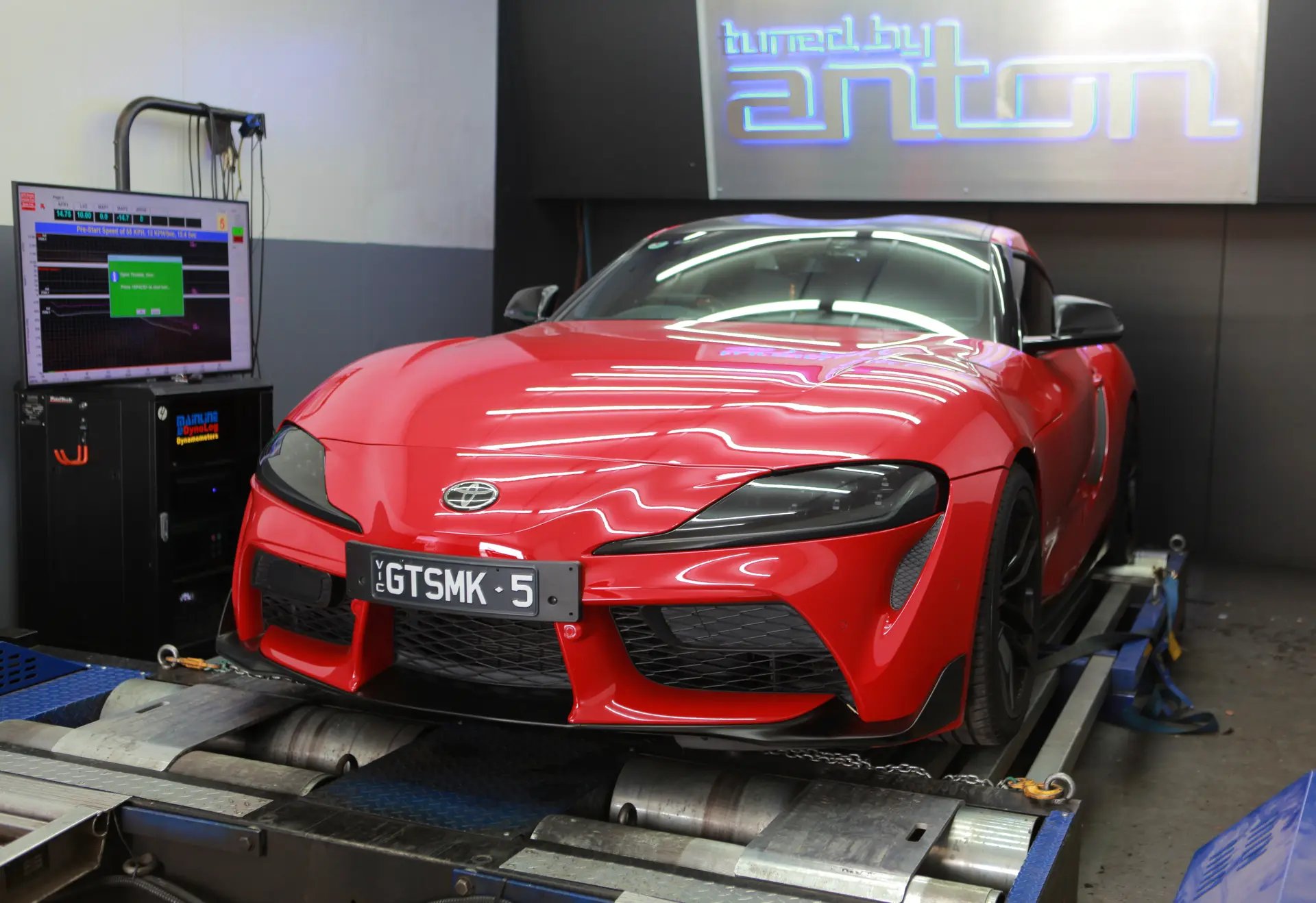
The car is driven onto the Mainline AWD dyno and strapped down. The exhaust probe is fitted to capture lambda readings in real time. The engine is brought to operating temperature, then driven through a full-throttle pull from low RPM to the rev limiter in a single gear. Three pulls are conducted and averaged.
The dynamometer measures:
03 · What the data tells you
Three questions
one run answers.
Peak figures are only part of the picture. The data from a baseline run answers three questions that no spec sheet can.
Is the car making what it should?
Factory power figures are quoted at the flywheel (crankshaft). A dyno measures at the wheels, after drivetrain losses: typically 12–18% for FWD, 15–20% for RWD, and 18–25% for AWD. A car running significantly below its expected wheel figure may have a failing turbo, clogged injectors, a boost leak, or worn piston rings. The baseline reveals this before money is spent on a tune.
Where is the power being made?
The shape of the power curve tells you as much as the peak figure. A healthy turbocharged engine builds progressively and holds to the rev limit. A curve that peaks early and falls away suggests a boost drop-off, intercooler heat soak, or a restrictive exhaust. A flat torque curve on a naturally aspirated engine suggests camshaft wear or valve timing issues.
What is the fuel doing?
Lambda readings from the exhaust probe show whether the engine is running rich or lean across the RPM range. A rich reading at cruise is normal. A lean reading (lambda > 1.0) under full load is a safety concern, particularly on a turbocharged engine where lean conditions at high boost cause detonation.
04 · When to book one
Six situations
where it pays off.
A baseline run is not just a pre-tune formality. These are the situations where the data it produces is genuinely worth having.
05 · Baseline vs full tune
Measure first.
Tune second.
A baseline run measures but does not change anything. The ECU calibration is not touched. The session produces power and torque figures and a set of data logs. Total session time is 1–1.5 hours.
A full dyno tune modifies the ECU calibration and verifies the result under load. It takes significantly longer, typically 4–6 hours, and costs proportionally more. See the 2026 dyno tune pricing guide for a full breakdown.
How customers use it
Many customers book a baseline first, review the data with us, then decide whether a tune is the right next step, or whether the car needs mechanical attention first. It is the most cost-effective way to avoid spending money on a tune before the engine is ready for one.
06 · Limitations
What a baseline
cannot tell you.
- What the engine will produce after a tune: a baseline shows current state, not potential
- Internal engine condition: compression and leak-down tests are separate procedures
- Long-term reliability: a single dyno pull measures output, not durability
If you suspect a mechanical issue, a compression test and leak-down test alongside the baseline will give a much more complete picture of the engine's health before any tuning work is discussed.
07 · Frequently asked
The questions
we hear every week.
Ready to book?
Know your numbers
before you spend.
Book a baseline dyno run at Tuned by Apex, 9/21 View Rd, Epping VIC 3076. AWD, RWD and FWD vehicles welcome on our Mainline AWD dyno. From $250.
9/21 View Rd, Epping VIC 3076 · Mon-Fri 8am–5pm
Related reading