Online tune vs
dyno tune: what's
the difference?
Online tunes are cheaper. Dyno tunes are verified. Here is the honest comparison — what each involves, where the risk sits, and when an online tune is and isn't good enough.

Tuned by Apex Workshop
Mainline AWD dyno · 1,500+ tunes · Epping, VIC
TL;DR · the short version
Online tunes are cheaper ($200–$800) and faster, but they are written blind — the tuner never sees your car running under load.
A dyno tune verifies boost pressure, air-fuel ratio, exhaust gas temperature and knock in real time, catching hardware discrepancies and unsafe conditions an online tune cannot detect.
Online tunes are reasonable for Stage 1 on a well-documented, stock car on a well-supported platform (VW MQB, BMW B58, Subaru FA). Anything above Stage 1, modified, E85, or diesel needs a dyno.
Dyno tunes cost more ($800–$1,800+), but on a modified or high-power build the risk difference is large, not marginal.
01 · What an online tune is
A file, written
blind.
An online tune is a calibration file written by a remote tuner and delivered over the internet. The tuner does not see your car, does not run it under load, and cannot verify that the tune is safe or producing the expected output on your specific vehicle.
Most online tunes are built from a known base map, developed on a vehicle similar to yours, and modified for your described hardware list. Some platforms (Subaru via COBB, BMW via MHD) allow the tuner to refine the map based on data logs the customer sends back. This is better than a pure off-the-shelf file but still not a dyno calibration.
What an online tune costs: typically $200–$800. Some are sold as flat files with no revision. Others include a data log review service where the tuner adjusts the map based on your feedback.
02 · What a dyno tune is
Verified under
real load.
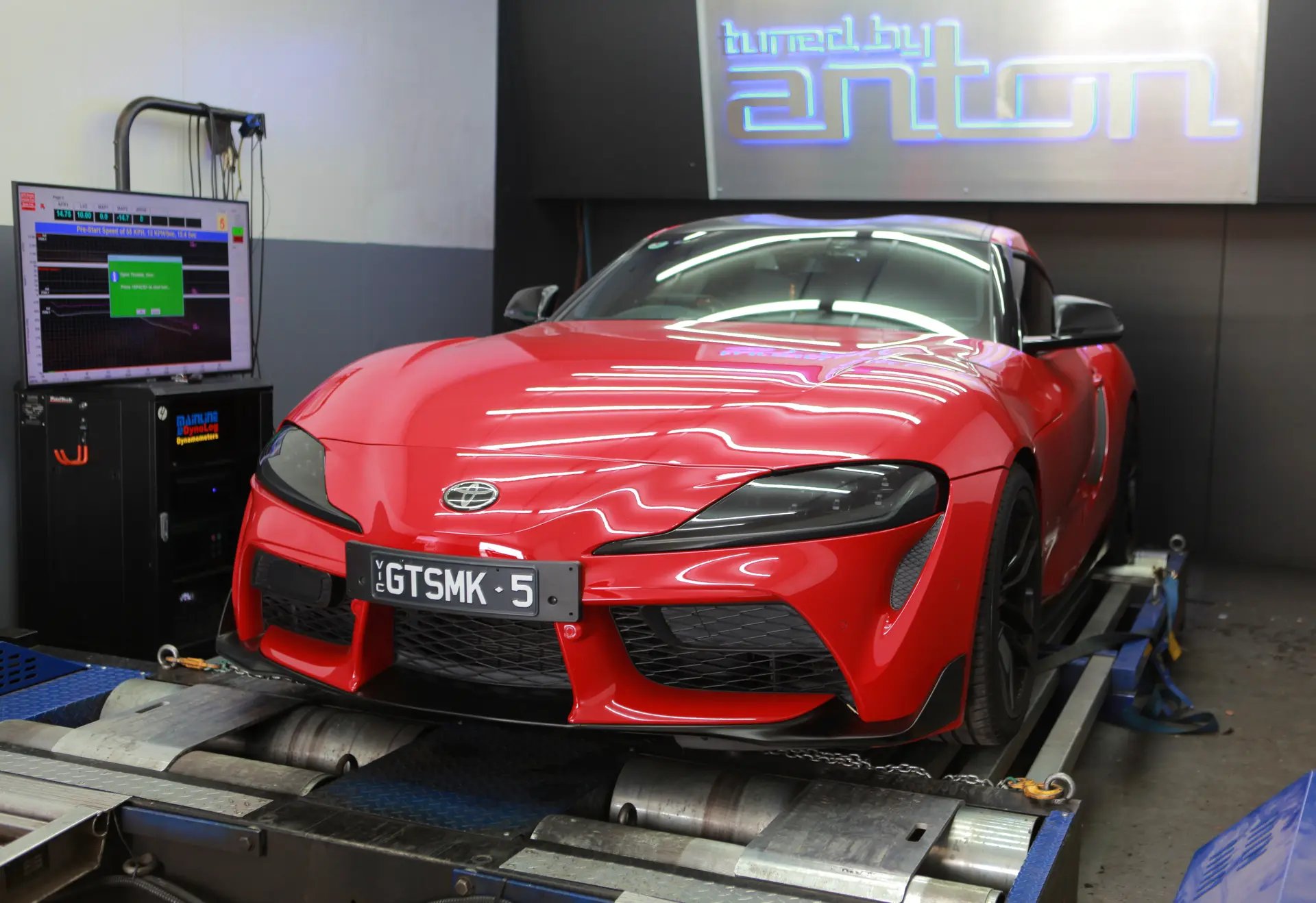
A dyno tune is a calibration developed and verified with the car running under load on a dynamometer. The tuner sees the live data — boost pressure, air-fuel ratio, exhaust gas temperature, knock events — and refines the calibration in real time until the data confirms the engine is running correctly at every operating point.
The result is a tune that has been verified on your specific car, with your specific hardware, on the day, in your ambient conditions.
03 · Where the risk sits
Two risks
follow an online tune.
An online tune is written based on what the customer describes. That introduces two specific risks.
The description is wrong or incomplete
A customer says the car is stock. In reality a previous owner fitted a different injector set, or the intercooler was upgraded without the current owner knowing, or there is a boost leak. The online tune is calibrated for a car that does not match the actual hardware. On a dyno, these discrepancies are found in the first 10 minutes.
The tune cannot be verified
An online tune that feels good on a part-throttle test drive may be operating dangerously at full throttle in high ambient temperatures. The driver has no way of knowing unless the engine fails, at which point the failure has already happened.
What we see on the dyno
We have seen engines damaged by online tunes that were operating on lean air-fuel ratios the customer had no way of detecting. A wideband gauge and data logging setup can mitigate this risk, but it does not replace a dyno calibration.
04 · When online is reasonable
Stock cars, modest
targets, good data.
An online tune is a reasonable choice in a specific set of circumstances, mostly where the car is stock, well documented, and the platform has a mature online tuning track record.
Reasonable when
- Stage 1 on a well-documented, stock car on a platform with a large, well-established online tuning community (VW MQB, BMW B58, Subaru FA)
- A budget build where the power target is modest and the car is driven conservatively
- A platform where the remote tuner has access to your data logs and revises the tune based on actual feedback
- As a starting point before a later dyno refinement session
05 · When dyno is the right choice
Six reasons to
book the rollers.
- Any build above Stage 1 — supporting hardware creates too many variables for a remote tune to address
- Modified engines — any deviation from stock hardware must be verified under load
- E85 tunes — fuelling system adequacy must be confirmed on the dyno before committing to E85 calibration
- High-power builds — the consequences of an incorrect tune scale with the power level
- Diesel tunes — combustion characteristics in diesel engines vary by condition and require real-time data
- Any car where reliability and engine longevity are a priority over saving $500
06 · Is it worth it?
The cost
difference.
Side by side, the price gap is easy to see. The risk gap is the part that is easy to miss.
07 · Frequently asked
The questions
we hear every week.
Ready for a real dyno tune?
Every tune here
is a dyno tune.
Every tune at Tuned by Apex is calibrated and verified on the Mainline AWD roller dyno in Epping. Call the workshop or submit a quote and we'll confirm the right approach for your car.
9/21 View Rd, Epping VIC 3076 · Mon-Fri 8am–5pm